
Here’s something nobody tells you about enterprise technology budgets: they’re massive, complex, and almost completely invisible. Ask most CIOs where their $50 million IT budget actually goes, and you’ll get hand-waving about “infrastructure investments” and “strategic initiatives.” Ask them what the unit cost of their email service is, or which cloud resources are sitting idle, or what their actual ROI on that expensive security platform looks like, and watch the conversation get uncomfortable.
This isn’t incompetence. It’s infrastructure. Most organizations are still managing nine-figure technology budgets using tools designed for personal finance. The result? Billions of dollars allocated based on educated guesses, historical precedent, and whoever argued most convincingly in last quarter’s budget meeting.
IT Financial Management platforms exist to fix this disconnect. They’re not accounting software. They’re intelligence systems that answer questions like: What does this service actually cost? Where is money being wasted? Which investments are creating value and which are just creating expense? This guide explains how to choose one that actually works for your organization.
What Is IT Financial Management (ITFM)?
Defining ITFM in the Modern Enterprise
Gartner describes IT Financial Management as the discipline focused on managing technology expenditure, establishing transparent cost visibility, and enabling accurate financial forecasting. That’s technically correct but misses the emotional truth: ITFM is about finally being able to answer the CFO’s questions without panic.
The status quo in most organizations looks like this:
- Financial data is scattered across incompatible systems. Your technology costs live in the general ledger, cloud provider portals, contract management databases, and approximately two dozen spreadsheets maintained by people who left the company three years ago.
- Simple questions take days to answer. When someone asks what you’re spending on a particular capability, the answer requires pulling reports from five systems, manual reconciliation, and several rounds of “wait, that can’t be right”.
- Conversations focus on explaining the past, not planning the future. Budget meetings devolve into forensic accounting exercises. Why did cloud costs spike last month? Where did that extra headcount spend come from? You’re perpetually on defense.
ITFM’s promise is strategic transformation. Stop being “the expensive department that needs budget justification” and become “the strategic function that deploys capital to drive measurable business outcomes”. It’s a completely different conversation.
ITFM vs. TBM vs. FinOps: Understanding the Ecosystem
These three acronyms get thrown around interchangeably in vendor presentations, which creates unnecessary confusion. They’re related concepts but serve different purposes:
- ITFM is the overarching discipline. Everything related to managing technology finances—planning, tracking, allocating, forecasting, optimizing—falls under this umbrella.
- TBM is the standardized framework. Technology Business Management provides the common vocabulary and classification system for connecting technology costs to business value. Think of it as the grammar that ensures everyone speaks the same language.
- FinOps tackles cloud-specific challenges. Financial Operations focuses specifically on the unique problem of variable cloud costs, bringing engineering and finance teams together to optimize consumption patterns.
Modern platforms blur these boundaries productively. MagicOrange, for instance, handles enterprise-wide ITFM requirements, applies TBM taxonomies for consistent classification, and includes specialized FinOps modules for cloud optimization—all in one platform. When these pieces work together, you get something genuinely powerful.
The Spreadsheet Tipping Point: When to Upgrade
Excel is a remarkable tool. It’s also completely inadequate for enterprise technology finance. For small organizations with straightforward budgets, spreadsheets work fine. But as complexity grows, the limitations become crippling:
- Manual work scales linearly with complexity. Every new cost center, every additional allocation rule, every budget scenario requires manual intervention. Change one assumption and you’re updating fifty formulas across three linked worksheets.
- Errors compound invisibly. Studies consistently find that most complex spreadsheets contain mistakes. The problem isn’t carelessness—it’s that spreadsheets weren’t designed for this level of interconnected logic.
- Collaboration becomes a coordination nightmare. When multiple people need to work on the same budget model, version control becomes your full-time job. You spend more time reconciling differences than analyzing spending.
| When Do You Actually Need a Real Platform? |
| According to Nicus research, organizations with annual IT budgets below $25–40 million can usually manage with well-maintained spreadsheets. Cross that threshold, or find yourself in a high-growth phase where financial agility matters, and spreadsheets stop being tools and start being constraints. |
Key Capabilities to Look for in ITFM Software
Data Aggregation & Normalization (The “Single Source of Truth”)
The first job any ITFM platform needs to handle is pulling together all your scattered financial data: general ledger entries for traditional technology spending, cloud provider APIs for infrastructure costs, vendor management systems for contracts, asset databases for hardware. But aggregation alone isn’t sufficient.
Each source uses its own classification system. Your cloud bill organizes costs by resource type and region. Your accounting system categorizes by department and GL code. Your procurement database tracks by vendor and contract term. A capable platform doesn’t just collect this data—it normalizes it into a coherent structure you can actually analyze.
Here’s where most implementation projects get stuck:
| Organizations delay ITFM implementation waiting for clean data. Nicus puts it bluntly: “Attempting to rectify bad data beforehand… is an open-ended and chaotic exercise”. Modern platforms are designed to handle messy inputs. They flag anomalies. They improve iteratively. Waiting for perfect data before starting is how projects die in planning committees. |
Service Costing & TCO (Total Cost of Ownership)
After consolidating data, you need true service-level costing—understanding the complete, loaded cost of delivering each technology service. This means accounting for:
- People costs. Full compensation for everyone who builds, operates, or supports the service—including benefits and overhead allocations.
- External vendor costs. Licenses, SaaS subscriptions, support contracts, professional services.
- Infrastructure costs. Hardware depreciation, data center expenses, cloud compute and storage charges.
- Shared service allocations. Proportional costs for network, security, and governance infrastructure that supports the service—often the most politically charged allocation.
This transforms your understanding from “we spent $80 million on IT last year” to “our email platform costs $3.85 per user per month, and here’s exactly why.” That level of precision enables optimization conversations that aggregate numbers can’t support.
Budgeting, Forecasting, & Predictive Analytics
Traditional IT budgeting is an annual ritual that becomes obsolete almost immediately. You build projections in November based on current assumptions, finalize them in December, and watch them become inaccurate by February. Progressive ITFM platforms replace this with dynamic, continuous forecasting that updates as reality changes.
Artificial intelligence is making this genuinely intelligent. IBM Apptio uses machine learning to identify spending anomalies before they hit your books. MagicOrange correlates cloud consumption with business activity patterns, enabling scenario modeling at scale. These aren’t roadmap promises—they’re production capabilities today.
Moving from explaining past variances to predicting future needs is one of the most valuable capability advances in modern ITFM.
Showback vs. Chargeback Automation
How you attribute technology costs to consuming business units is fundamentally a strategic choice:
- Showback provides transparency without consequences. Business units see detailed breakdowns of their technology consumption and costs, but nothing hits their P&L. The goal is informed decision-making.
- Chargeback creates financial accountability. Costs are formally allocated to consuming units’ budgets. This creates real market dynamics internally but requires exceptional confidence in your methodology and tolerance for disputes.
Either approach requires what practitioners call a “defensible bill”—cost breakdowns detailed enough that business leaders can interrogate the methodology, challenge assumptions, and ultimately accept the results. Quality ITFM platforms automate these calculations and produce audit-quality documentation.
Top IT Financial Management Tools Reviewed (2026)
The platform landscape has matured significantly. Here’s what actually distinguishes the major players, beyond the marketing spin.
IBM Apptio
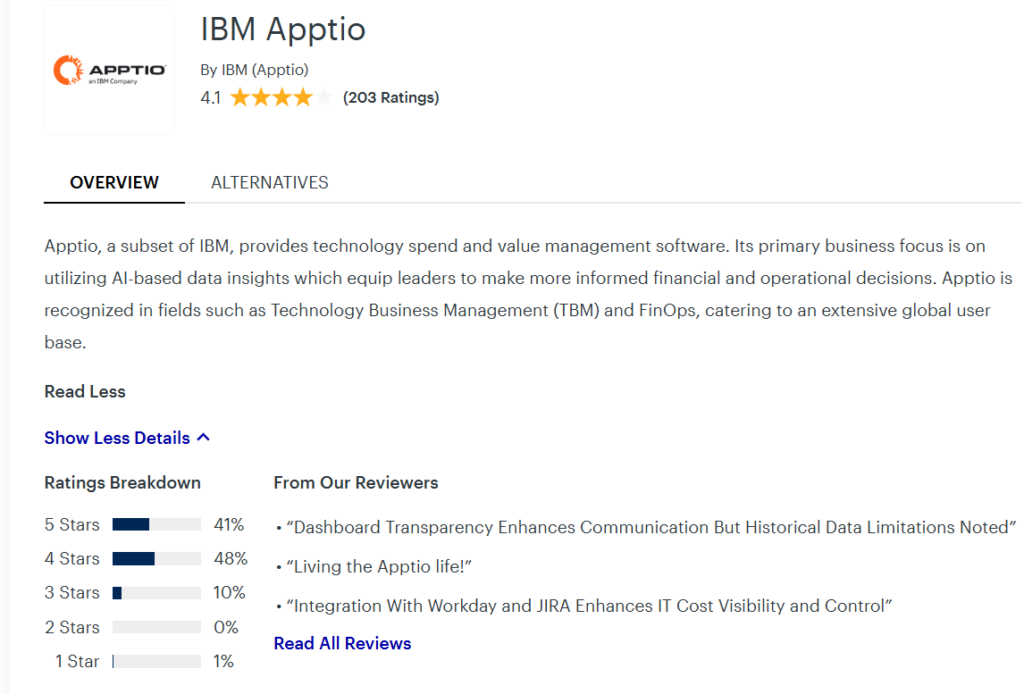
Positioning: The category creator and still the market leader. Apptio essentially invented TBM and positions itself as the “Financial Intelligence Layer” for complex enterprises.
What sets it apart:
- Built-in intelligence. Machine learning models automatically identify spending patterns, forecast budget impacts, and recommend optimizations.
- Framework authority. Apptio created the TBM taxonomy that’s become an industry standard. Their FinOps capabilities handle multi-cloud environments comprehensively.
- Enterprise architecture. Designed for organizations with thousands of cost centers, complex allocation rules, and global operations.
Reality check: this capability comes with corresponding complexity. Smaller organizations should look elsewhere.
Nicus
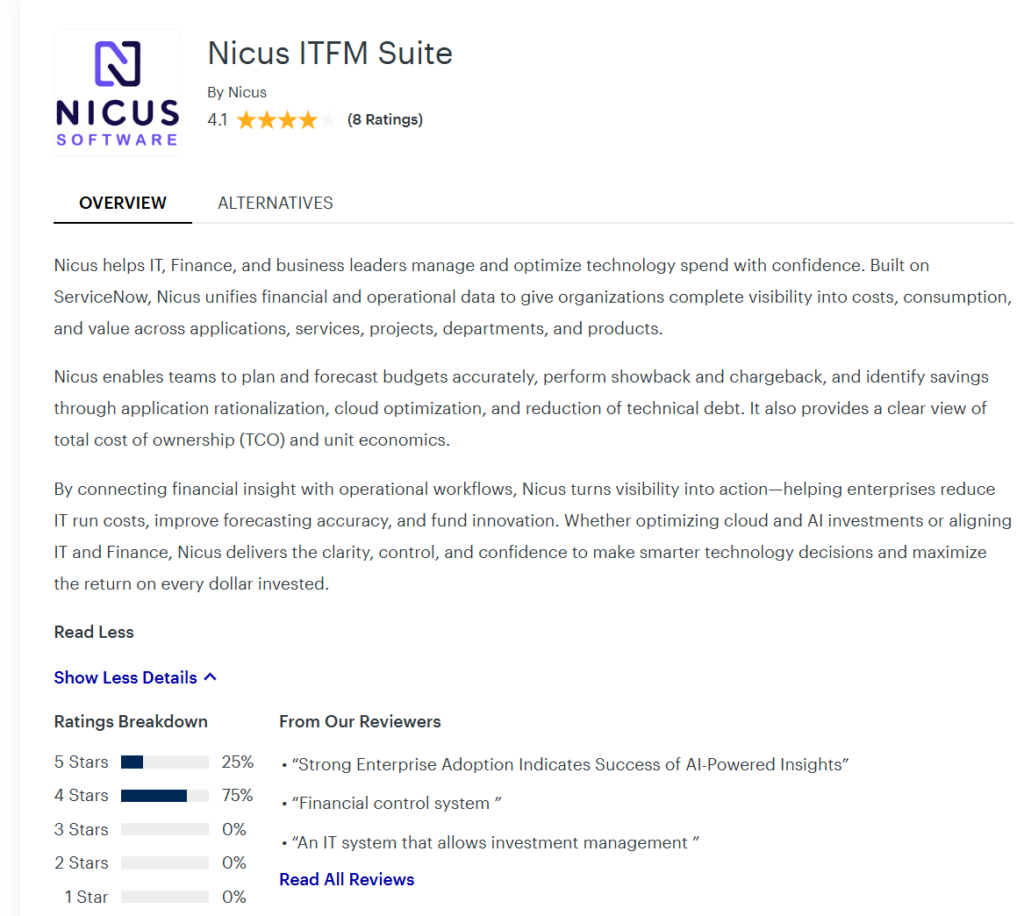
Positioning: The ServiceNow-native option. Nicus runs inside ServiceNow rather than as separate software, which fundamentally changes the value proposition.
Key advantages:
- Direct CMDB access. Because it operates within ServiceNow, Nicus consumes your existing configuration management database. No duplicate asset tracking. No parallel data management.
- Rapid implementation. The platform is architected for speed, producing functional cost models in weeks rather than quarters.
- No headcount expansion. Nicus claims organizations can implement comprehensive ITFM without hiring additional staff by integrating into existing workflows.
The catch: if you’re not already committed to ServiceNow, these integration benefits evaporate. Architectural lock-in cuts both ways.
MagicOrange
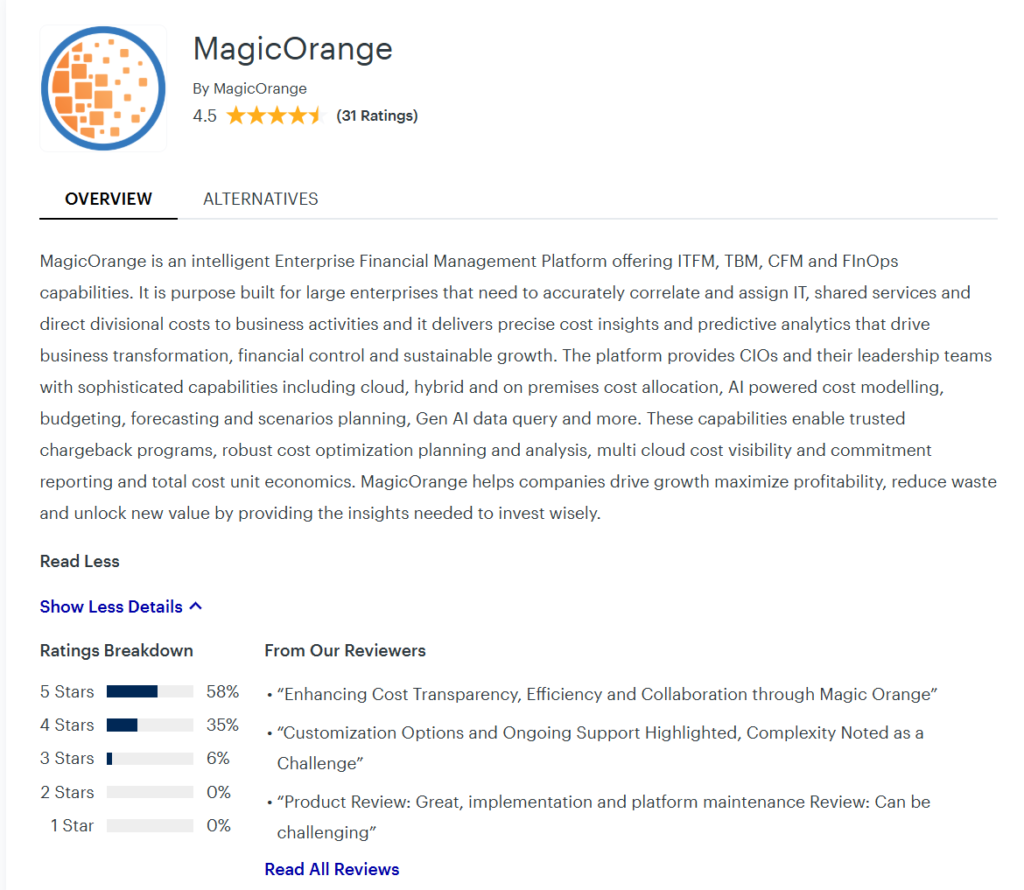
Positioning: Cloud-native with a profitability focus. MagicOrange goes beyond cost management to emphasize profit optimization—connecting technology spending to revenue outcomes.
Distinctive capabilities:
- Azure foundation. Built natively on Microsoft Azure, inheriting that platform’s security, scalability, and integration capabilities.
- Shared cost intelligence. Particularly strong at allocating shared infrastructure costs to consuming services and business units.
- Revenue connection. Uniquely, MagicOrange can correlate technology costs with revenue data, enabling profitability analysis of technology-enabled services.
Trade-off: Azure-native architecture is powerful within that ecosystem but creates dependencies outside it.
Upland ComSci
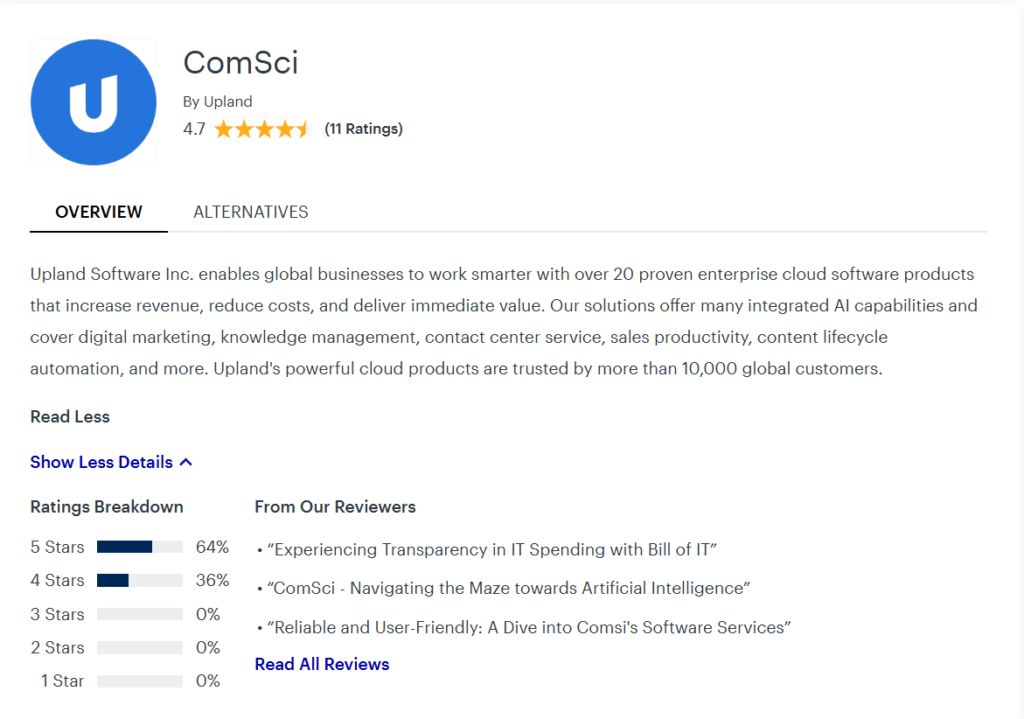
Positioning: The managed service play. Upland ComSci doesn’t just sell software—they offer “ITFM as a Service” with a dedicated team operating the platform for you.
Why this matters:
- Aggressive timeline commitment. Upland publicly promises measurable results within 90 days through structured implementation.
- Telecom heritage. Deep roots in telecom expense management translate to strong contract optimization and invoice reconciliation capabilities.
- Outsourced operations. Their analysts configure, run, and optimize the platform, requiring minimal internal resources.
Strategic question: outsourcing ITFM accelerates results but means you’re not building internal capability. Long-term dependency is a real consideration.
Serviceware Financial
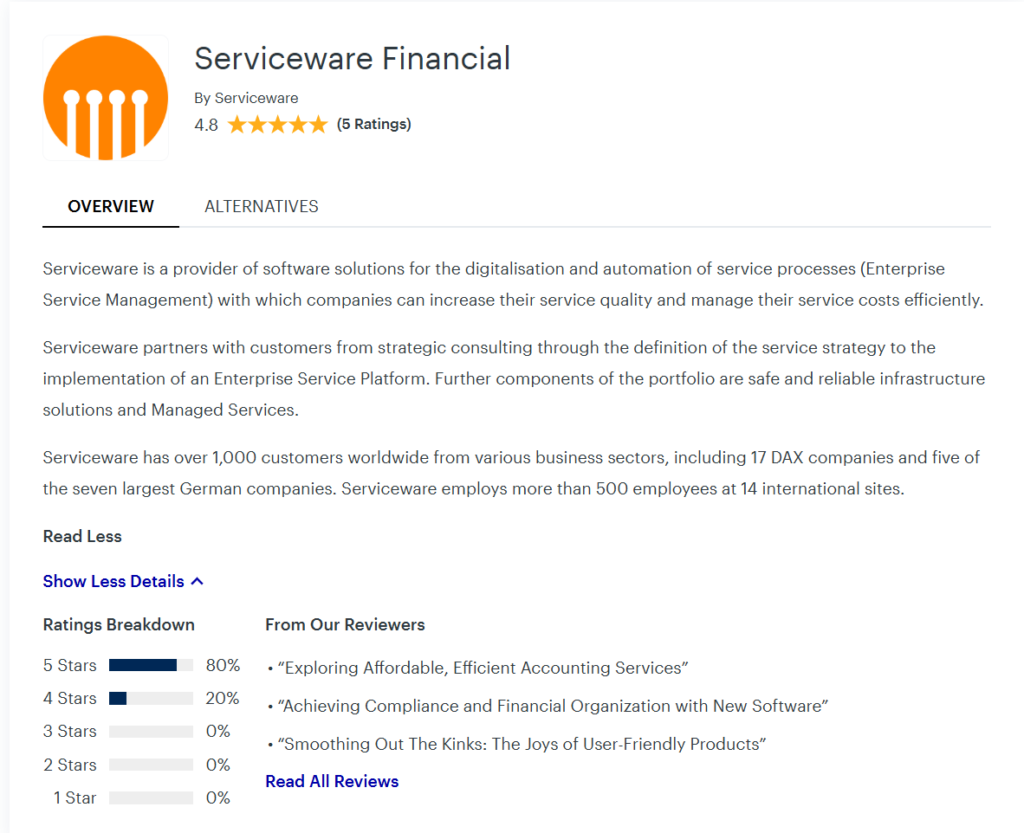
Positioning: European market strength with AI emphasis. Serviceware centers on their Digital Value Model—connecting technology investments to measurable business outcomes.
Platform strengths:
- Autonomous AI. Serviceware emphasizes “Agentic AI”—autonomous systems handling routine tasks like cost classification and anomaly detection.
- Service catalog integration. Deep connections ensure every cost ties to specific customer-facing services.
- Value methodology. Their Digital Value Model provides structured frameworks for measuring business outcomes from technology investments.
Geographic note: strong European presence but verify North American support coverage if that’s where you operate.
Notable Contenders & Niche Players
- ClearCost — SaaS-based platform targeting mid-market organizations needing visibility without enterprise complexity.
- Bee360 — Takes a Digital Twin approach, creating real-time simulations of technology estates for dynamic modeling.
- KP-One — Focuses on time-to-market optimization, helping redirect technology spending to accelerate product development.
Comparative Analysis: Architecture & Deployment Models
| Dimension | Standalone | ServiceNow-Native | Managed Service |
| Example | IBM Apptio | Nicus | Upland ComSci |
| Deployment | Cloud/On-Prem SaaS | Inside ServiceNow | Vendor-Operated |
| Data Strategy | Build new taxonomy | Use existing CMDB | Vendor-managed |
| Team Requirements | Moderate | Lower | Minimal |
| Typical Timeline | 3–6 months | Weeks to months | 90 days target |
| Best Fit | Complex enterprises | ServiceNow users | Constrained teams |
Standalone Platforms vs. ServiceNow-Native Apps
This architectural choice has long-term implications. Standalone platforms like Apptio operate as independent financial intelligence systems with their own taxonomies, data pipelines, and analytics. Maximum flexibility—at the cost of creating another data silo.
Nicus operates fundamentally differently by running within ServiceNow. Direct CMDB access. No duplicate infrastructure. Faster implementation with richer operational context.
Decision framework: if ServiceNow is already your IT operations foundation, native integration makes compelling sense. If you need capabilities beyond that ecosystem or don’t use ServiceNow, standalone platforms offer necessary breadth.
SaaS vs. Managed Services (The “Who Does the Work?” Question)
Traditional model: buy the platform, staff the team, run the system. That’s how most Apptio and Nicus implementations work.
Upland ComSci offers an alternative: professional teams that configure, operate, and optimize the platform on your behalf. Attractive if you lack internal expertise or need aggressive timelines.
However, Nicus argues that proper platform design eliminates the need for additional headcount. Honest assessment of your internal capacity should drive this decision.
Implementation Roadmap: From Day 1 to Value
The 90-Day Reality Check
Implementation timelines have compressed dramatically. Understanding what’s achievable matters.
- Upland ComSci commits to measurable value within 90 days through structured methodology.
- Nicus claims benefits within months by leveraging existing ServiceNow infrastructure.
Reality: these timelines are achievable with proper planning and organizational alignment. Your mileage varies based on data readiness and model complexity, but modern platforms implement far faster than previous generations.
Handling Data Sprawl & Quality Issues
Data quality concerns kill more ITFM projects than any other factor. The logic seems sound: clean data produces reliable models, so fix the data first.
This logic is wrong:
| Start Imperfect. Improve Continuously. |
| Nicus again: “Attempting to rectify bad data beforehand… is an open-ended and chaotic exercise”. Modern platforms handle messy inputs by design. They flag issues. They improve iteratively. Waiting for perfect data is how projects stall permanently. |
Practical approach:
- Weeks 1–4: Baseline. Ingest everything. Accept imperfections. Establish starting point.
- Weeks 5–8: Model. Build initial cost models. Generate reports. Identify highest-impact improvements.
- Weeks 9+: Refine. Iterate based on feedback. Address data issues based on actual impact. Expand capabilities.
Pricing Models & ROI (What to Expect)
Platform costs vary based on estate size, users, and service model. More useful: understanding return patterns you should expect.
Returns appear in two forms:
- Immediate waste recovery. Unused licenses, overprovisioned resources, redundant contracts. Organizations typically find 15–30% of technology spending in optimization opportunities with genuine visibility.
- Strategic velocity. Faster decisions, better resource allocation, stronger budget defense. When leadership answers spending questions immediately instead of after days of analysis, organizational agility improves fundamentally.
Build your business case around both: quantifiable waste you can eliminate and the organizational cost of delayed decisions. Conservative estimates typically justify investment within 12–18 months.
FAQ: ITFM Software Selection
“Is ITFM software only for Fortune 500s?”
Scale matters but not the way you think. Nicus identifies $25–40 million annual IT budget as the inflection point. Below that, disciplined spreadsheets often suffice. Above it, or in high-growth situations, purpose-built platforms deliver clear value.
Mid-market options: ClearCost for SaaS-based capabilities without complexity, Upland ComSci for managed service without large teams.
“How does ITFM differ from general ERPs?”
ERPs manage transaction flow—tracking accounts, processing invoices, generating statements. Essential but not designed for technology-specific analysis.
ITFM operates at different granularity:
- Specific service allocation instead of aggregate categories
- Unit costs per user, transaction, or capacity measure
- Consumption trends and predictive models
- ERPs track where money went. ITFM reveals what value it created.
“Can these tools handle Cloud/AWS billing?”
Cloud management is baseline. IBM Apptio includes FinOps modules for multi-cloud optimization [4][5]. MagicOrange provides deep Azure integration correlating costs with performance.
As cloud dominates technology budgets, FinOps capability is mandatory for serious platform evaluation.
Conclusion: Aligning IT Spend with Strategy
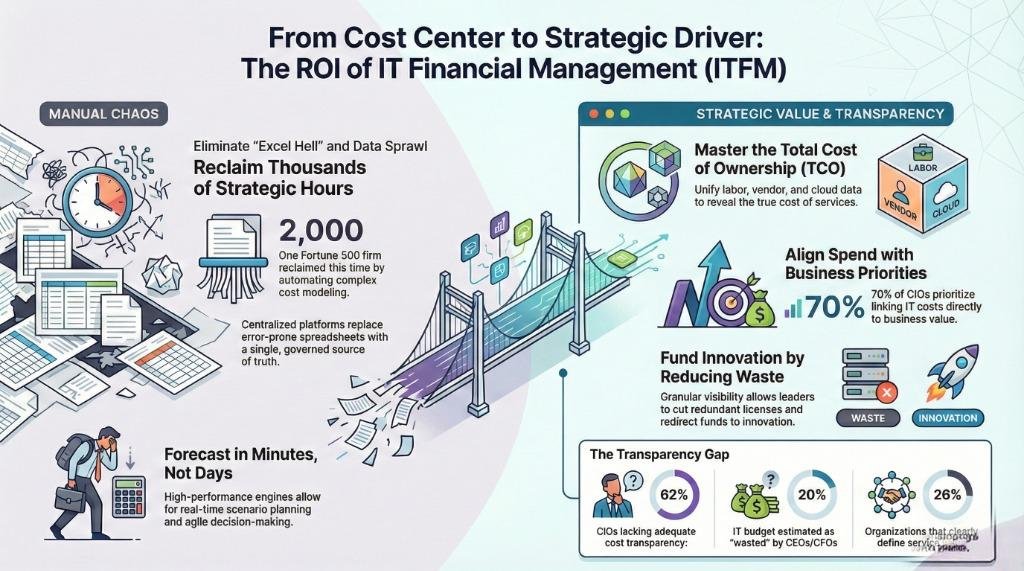
The old playbook is dead. Technology leaders can’t defend budgets with vague assertions about innovation and transformation anymore. Modern boards expect precise articulation of how technology spending connects to business outcomes.
IT Financial Management platforms make this possible. They transform scattered spending data into coherent intelligence. They create defensible financial narratives that convert adversarial budget negotiations into strategic planning sessions.
Whether you choose Apptio’s enterprise capabilities, Nicus’s ServiceNow integration, MagicOrange’s profitability focus, Upland ComSci’s managed service, or Serviceware’s AI automation, the imperative is identical:
| Stop operating without a net. |
| Organizations leading the next decade aren’t those with the biggest budgets. They’re the ones that understand—precisely, granularly—how technology spending maps to business value. ITFM isn’t back-office bookkeeping. It’s strategic capability that separates leaders from followers. |